
Can I Ask a Question?
by Sean McDivitt
Often times, in our journeys of healing, we become more aware of the depths and dimensions of our religious and relational experiences, injurious or otherwise. Naturally, we might ponder the validity or veracity of the things we once believed to be infallible or indestructible. At times, it may feel fearsome or even impermissible to broach the idea of even questioning.
After all, wasn’t the first sin “Hath god said?” Or so we learned.
For some of us, considering that question was the first sign of apostacy, of turning our back. It was the first step in abandoning the truth that we were to cherish and to use as a plumbline or a measure against which we were to sift out error or identify the counterfeit.
Perhaps we shuddered at the thought, a virtual no-man’s land.
The purpose, it was said, was to protect us from evil.
Yet it was also a foundational element wielded to control how we were to think at all. If at all. We were taught it was a worldview, and that against our worldview were a million warring others. Others that were all wrong, of course, while ours was the right. In fact, stepping outside of the ordained constructs by questioning divine authority, divinely ordained authority, or the consistency of our beliefs, even in our hearts, was preached against and vilified, almost the root of evil.
But somehow, questioning—condemned as it was—was also a central tenet. We saw it in “testing the spirits,” or Jacob wrestling with god, examination of scriptures, Mary’s faith in questioning versus Zacharias’s lack of it.
Somehow, some questioning was okay, while other questioning was not. And if we couldn’t figure out from the text whether it was truly okay or not, the gap was conveniently filled in by examining (somehow) “how” the questioning was done. Then based on the kind of response, we then illuminated for ourselves that those who received blessing did it with an upright heart, whereas those who did not receive a blessing or who received a consequence did so because they had a sinful heart.
All of that to ask a question.
To think, “Does this actually make sense?” Or, “What if we’re wrong?”
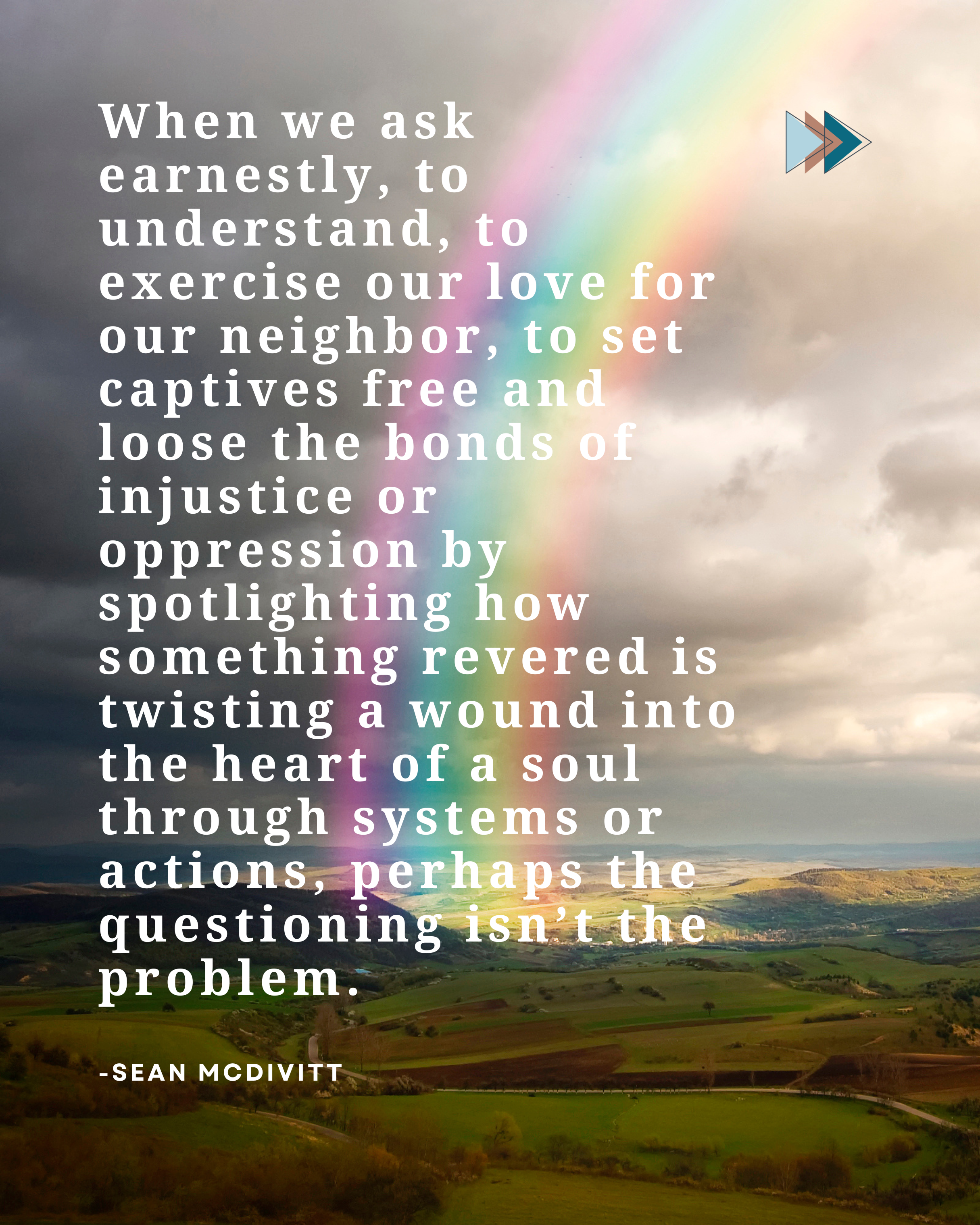
Asking questions is how we understand and discern the world around us. When we ask earnestly, to understand, to exercise our love for our neighbor, to set captives free and loose the bonds of injustice or oppression by spotlighting how something revered is twisting a wound into the heart of a soul through systems or actions, perhaps the questioning isn’t the problem.
Perhaps asking a question itself is necessary to ensure that the plumbline is, indeed, true. Maybe it isn’t the absolute answer we’d supposedly find and rest upon. If we ask the question and find that it reveals either the endurance of the original structure or a crack in its credibility, wouldn’t we want to embrace that transparency and actually get it right?
Indeed, in science, law, and philosophy, asking questions is at the heart of understanding, more than even finding answers. According to Dr. Ronald Vale, good questions “start a process of inquiry . . . [R]esearching one question often results in a further round of questions that dig deeper into a phenomenon.”
And different kinds of questions can shed light on different perspectives. For example, questions can uncover biases we didn’t realize we held. Moreover, when or where we ask a question can highlight “perspectival uniqueness of [one’s] social locations and individual histories” that might otherwise be unacknowledged, according to Cristina L. H. Traina, from the University of St. Andrews. Questions can help shift perspectives about a given situation from the perspective of the one wielding authority to the one affected by the one wielding authority.
Asking questions, then, is not—and never was—a place of danger. It’s simply how we learn, how we understand, how we interact with the world around us.
Beginning to ask questions can be scary, maybe even feel dangerous. We may feel we don’t have the words or the adequacy. We may feel the words we do know don’t begin to describe the feelings and the experiences we ache to express.
As Pride month comes to a close, asking questions is what has helped me see former beliefs or values that I though I’d left behind in new light. Questions like “who is my neighbor” persist in my mind. That deep hatred that should have divided a Samaritan from ever helping a Jewish traveler, or from that traveler from receiving the help bestowed, was bridged by love. And so I ask, who might replace those parabled characters in modern times?
Asking questions is how I find healing for my younger self who knew at age 13 that I was gay. I ask what love would have helped me amid the struggle to “crucify the flesh”? To preserve myself for courtship? To overcome the thorn in my flesh? To wrestle with my god until the break of dawn? How can loving now mend the frayed ends of grief, of anger, of pain, of sorrow, from leaving those beliefs behind and knowing that loved ones, still, are caught in their grip?
At the Religious Trauma Network, asking is okay. Asking how we understand, how we might “deconstruct,” how we might reconstruct, how we may change, or how we may grow.
We can ask each other. We can ask in community. We can ask in personal reflection.
So ask away.

Sean McDivitt is a member of Religious Trauma Network’s Advisory Panel.
This article is not intended to treat or diagnose any condition. Sean is not a licensed therapist or clinician. Any advice or opinions given on this site are strictly individual observation and insights based on personal experiences and study. It should in no way take the place of professional assistance.