
Interpersonal Conflict
by A Relevant Party
I am a person without family. That matters to everything that followed. I was new to the area, had no support system, and carried the kind of loneliness that reshapes how you move through the world. I rarely trusted anyone. But she was a priest. That title carried an implied covenant of care, and because of it, I trusted her fully.
The Anglican Church in North America ordains women to the priesthood. My rector was female. She was perceptive and warm, and she recognized my vulnerabilities early: no family nearby, difficulty trusting, social anxiety. For the first time in my life, I felt truly seen. She did not speak in generalities about community. She was specific: I was part of her family, not just the congregation. She made it clear this was something set apart from her role. I did not yet understand the cost of believing that.
What she built was not merely a pastoral relationship; it was something far more personal because she called me family. She included me in birthdays, dinners, and gatherings unrelated to ministry. She invited me into her home and asked me to watch her children. She told me nothing I did would push her away and urged me to put down roots in the city, insisting when I hesitated. Over time, the boundary between pastoral care and personal friendship dissolved through a pattern she had initiated, appeared to want, and continued to encourage.
I let my guard down. I needed belonging. Her role as my rector implied safety and trust. I did not yet understand how those could work against me.
When She Pulled Away
At some point, something shifted. Warmth became distance. Inclusion became silence. Confused and blaming myself, I asked to meet, hoping to share more of my past so she could understand. I believed there had been a misunderstanding.
Almost immediately, the meeting stopped being mine. Before I could speak, she redirected the conversation. The person across from me felt unrecognizable. Her warmth now became cold. I felt attacked. In shock, I could not reconcile the person I was seeing with the person I thought I knew. I was being called "unsafe," a word no one had ever used to describe me.
What followed was not the conversation or meeting to clear up a misunderstanding that I had anticipated. Instead, I was handed a verdict. I was labeled as having a "victimization mentality. I created "static in relationships" and was "co-dependent." She traced a line across the table and repeated “boundaries” as both accusation and punishment. What she did not acknowledge was that she had cultivated the closeness she now condemned. She had pushed for it, insisted on it. The traits she labeled as problems were ones she had encouraged.
When I shared my experience of what had happened - her invitations, her language, her insistence - she asked, “How long did you think this was going to last?” The question reframed everything that had come before it.
I had no answer. I hadn’t asked for any of it. I hadn’t known there was a timer. The label placed on me was one I didn’t know how to fight. I had not yet learned that silencing often
begins not with a command, but with a rewriting of the story so complete you lose the words to tell it. By the time you recognize it, you are already at a disadvantage.
The Removal
What followed was not mutual. It was an exercise of institutional power.
Using her position as rector, I was removed from children’s ministry and my community group. These were not quiet conversations. They were decisions backed by authority, accompanied by a label: I was unsafe, had crossed boundaries, and could not be trusted.
There was not a single example provided of my unsafe behavior. There was no incident, complaint, or documentation. My background check was clean. I had served without issue. “Unsafe” was not a finding; it was a label applied from a position of power. Because it came from a priest, it was effectively unchallengeable. It spread through my community without any way for me to stop it, requiring no proof but carrying real consequences.
At mediation, she later admitted I had not done anything she considered unsafe. It was a feeling; she didn’t trust me to respect boundaries. A feeling; something you cannot defend against.
The Process That Protected Her
I followed the process I was told to trust. The diocese maintained a safeguarding policy promising an independent, third-party investigation for whistleblowers. I believed that. I filed a report.
What I experienced felt less like an investigation and more like institutional management of me, my account, and the outcome. The Ombudsman was on-staff clergy with a long professional relationship with both my rector and the bishop. There was no independent third party.
The structure prevented any meaningful challenge to those in power.
When the final report was issued, the abuse of power I described was reframed as “interpersonal conflict.” With that phrase, what happened to me was reclassified as mutual, ordinary, and partially my fault. That reframing was its own harm. The institution ensured my voice did not matter.
From the beginning, I had asked to speak with the Vestry, the church’s lay governing body. I was denied. My voice had no authorized channel.
At formal mediation, my rector acknowledged that everything she had offered - inclusion, invitations, and language of family - had been driven by her profession and perception of my vulnerability. She said she never should have used words like “friend” or “family,” that she had only ever seen me as someone in need.
That is not what she communicated at the time. At the time, she called me her sister, told me I was safe, and promised nothing I did would push her away. I believed her because she made me believe her. That is what grooming looks like: something that feels like care while it is happening, and only later reveals its cost.
The Letter
Desperate to be heard, I contacted the bishop. He told me he felt “triangulated,” despite his role being oversight and accountability. He advised me, for the sake of my healing and others, to find a different church, adding, “Another church is still the church.”
Shortly after, I received a letter from a church attorney prohibiting me from attending services, events, or private gatherings, and from having private meetings with members. I could not understand how a church could hire an attorney to ban someone over claims that had never been proven or independently reviewed. It felt like institutional bullying backed by legal authority, contradicting everything I believed the church to be.
The Vestry, whom I had been prevented from speaking to, were copied on the letter. They did not know my side. I was now legally restricted from telling them. That is institutional silencing at its most complete: a story written without you, distributed without you, and enforced so you cannot correct it.
The Cost
This was not just losing a church. It was losing an entire social world in a place where I had no one else. The label of “unsafe,” never substantiated, spread while I had no way to respond. People avoided me. A community I had been encouraged to call home became a place where I was viewed with caution.
Depression followed; quietly, then all at once. There were months I could not get out of bed. I lost my job. The physical toll was significant. I sought therapy but found that local providers were connected to the church. I reached out to advocacy organizations; some did not respond. That silence felt familiar. It reinforced the message that my story did not matter.
My relationship with God has become complicated. I question whether God exists at all and struggle to reconcile what happened with the idea of a loving God. I am not ready to let go entirely, but what faith remains exists outside institutions, in nature, in quiet, in things that ask nothing of me. Church no longer feels safe.
I trusted a priest, and she used that trust against me. I trusted the institution, and it protected her. I trusted the bishop, and he sent me away. Everywhere I turned for safety failed me. I no longer know how to believe safety exists, or that I deserve it. The harm is not abstract. It is ongoing.
Why I’m Writing
I am writing because silence allows these patterns to continue and keeps people like me hidden. In closed systems without meaningful external accountability, silence is essential. Those harmed have the most to lose by speaking. That is not accidental; it is structural.
Somewhere, someone is sitting in the same confusion I once felt, wondering if they imagined it, if they are the problem, why no one believes them. I know that person because I am that person. I am writing so they know they are not alone and can recognize this pattern before it happens to them.
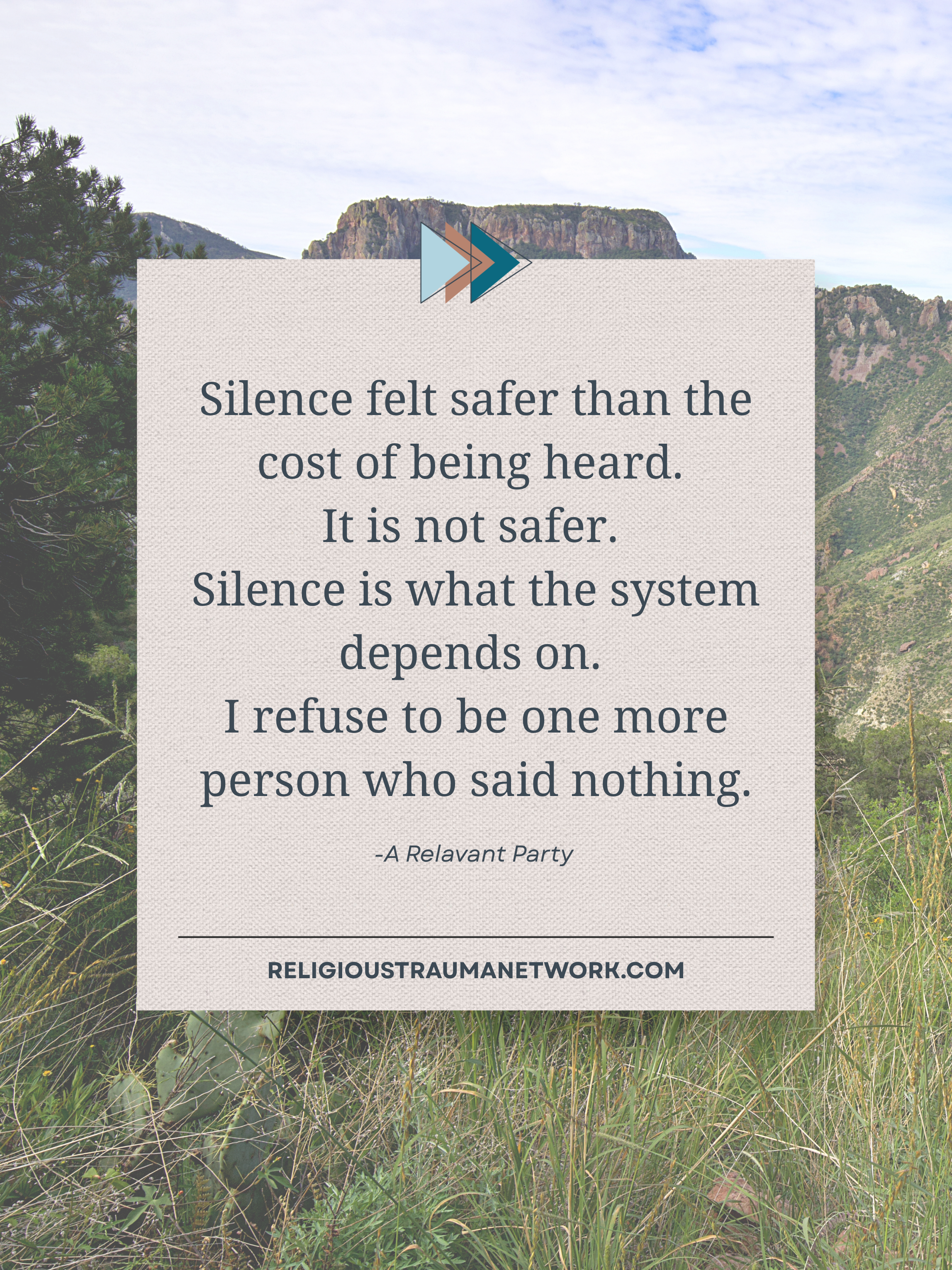
For a long time, I stayed quiet because I lacked the language, because every channel led nowhere, because silence felt safer than the cost of being heard.
It is not safer. Silence is what the system depends on.
I refuse to be one more person who said nothing.
About the Guest Author:
A Relevant Party was born Catholic and is a shunned Anglican, turned tree hugger who finds spirituality in nature. They are currently using their voice to speak out about spiritual abuse and its broader implications for church accountability and survivor advocacy.
Disclaimer:
The views, thoughts, and opinions expressed in guest blog posts are those of the individual authors and do not necessarily reflect the positions of the Religious Trauma Network. We recognize that each person’s healing journey is unique, personal, and courageous. The stories shared here belong solely to the contributors, and their experiences, perspectives, and advice may not apply to everyone. We encourage readers to honor their own paths and seek professional support as needed.