
Us 4 S’more: What sensations, tensions, or patterns have you noticed in your body that might be connected to past religious experiences?
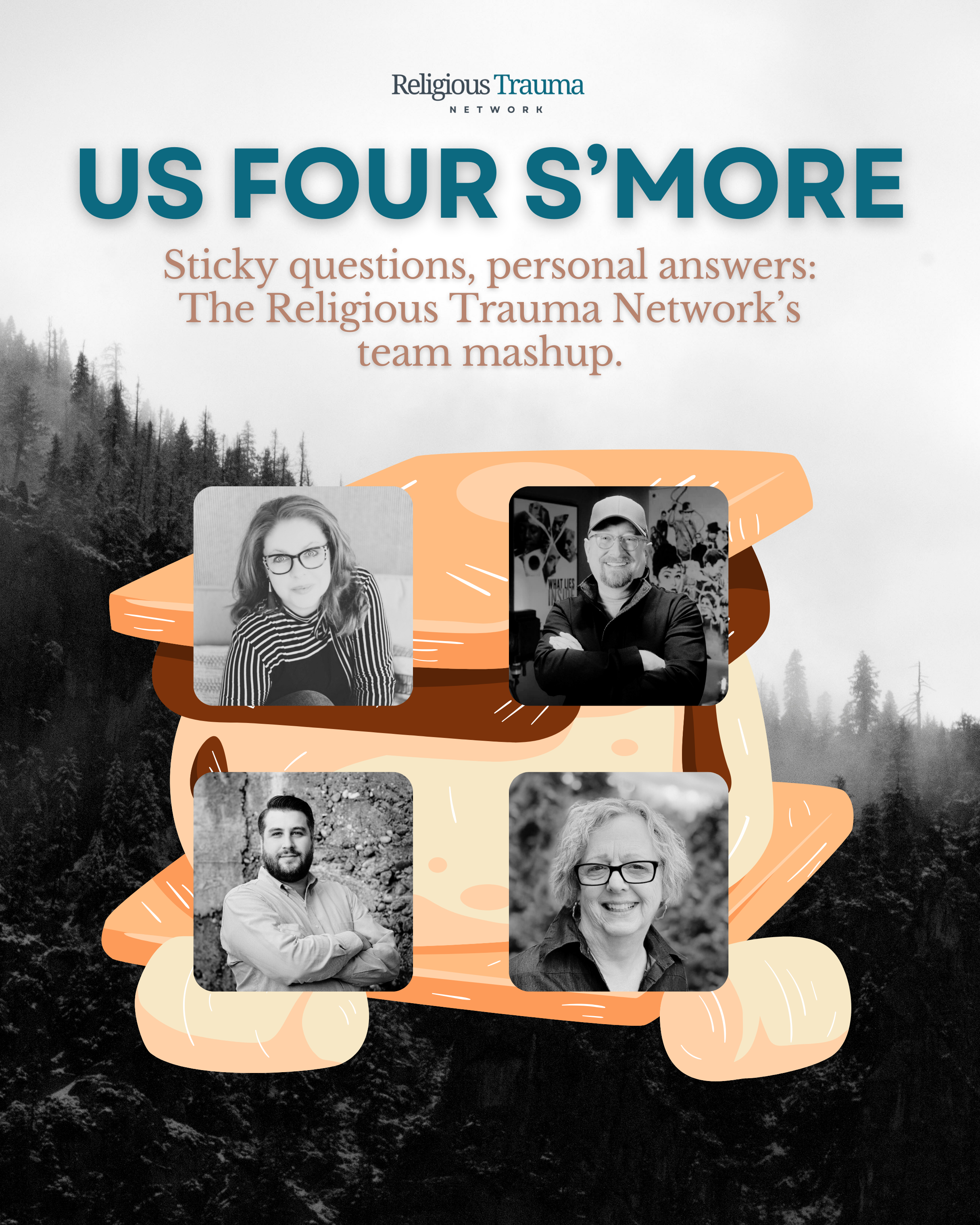
Sticky questions, personal answers: The Religious Trauma Network’s team mashup.
What sensations, tensions, or patterns have you noticed in your body that might be connected to past religious experiences?
Luke Renner
As it just so happens, I’m actually experiencing extreme anxiety responding to this query, so we can probably start my list with “occasional bouts of extreme anxiety.” Depression is also a major factor in my life, and a significant portion of that comes from my religious trauma.
In part, as I grow older and take my turn at being an adult, I can see for myself just how easy it is not to be a controlling, cruel, inattentive, abusive, or otherwise poorly-attached person in the world, who uses terror to scare children into compliance. This means that at least some of the pain from my childhood trauma is being experienced much later in life, increasing in step as my own capacity increases for forming new understandings of old experiences.
I’m fifty years old when I’m writing this, and my body has difficulty carrying around the depth and breadth of the well-intentioned deceptions, half-truths, false promises, thought policing, “discipline”, fear of eternal conscious torment in hell, and other physical and psychological torments that I endured, all at the hands of well-intentioned people. There’s a lot I’m not ready to talk about here, and I’ve probably said about all I can think of that is worth much for this entry. I guess if I had to boil this down into a teachable thought, I would say, if you’re considering healing from religious trauma, maybe be ready for a weird unfolding.
Trapped pockets of pain can come from memories that once brought a smile. The ground can feel unstable. The process can be very disorienting and out of proper sequence. If that happens to you, I don’t think you’re doing anything wrong. If anything, I suspect it’s yet another clue to the severity of the damage that spiritual trauma causes.
Rebekah Drumsta
I’ve learned to understand that my body has carried the impact of my religious trauma experiences in ways I didn’t connect for years. My childbirth story, the chronic migraines that have followed me, the tension that settles in my shoulders like it belongs there. Even the instinct to flee when I saw someone from my childhood church out in public — my body reacted before I had time to think. It knew something long before I could name it.
There are other patterns too. The flash of pain and shame when I watched a parent discipline their child in the “old” way. The panic that rose in my chest when I worried I was sinning. The way my body holds on to weight as a protective layer, a kind of armor.
A woman’s biology is already beautifully complex, but that complexity becomes deeper when shaped inside systems that teach women to distrust, fear and be ashamed of their bodies. Messages about modesty, shame, submission and female inferiority don’t stay in the mind. They settle into muscle memory. They shape posture, breath, appetite, sexuality and a woman’s sense of safety in her own skin. Add to that the expectation to carry, birth, educate, feed, bathe, spiritually train and clean up after as many children as God will give you, and the weight becomes more than emotional. It becomes physical. It becomes cellular.
These sensations and patterns aren’t abstract for me. They are the story my body has been telling for years. They are the places where my past religious experiences and the traumas I’ve experienced left an imprint…not because I was weak or dramatic but because the body remembers what the mind and soul had to survive.
Healing has shown up in layers for me, much like the harm did. Some layers live in memory, others in instinct and learned motion. As I’ve paid attention to the sensations shaped by my past religious experiences, I’ve learned that healing isn’t about erasing what happened but understanding how it settled into my body and letting safety and compassion slowly unwind it. Each layer asks for something different, and each one reminds me that healing is a steady and ongoing process, one honest layer at a time.
David Ruybalid
I didn’t understand trauma for years. It wasn’t even a word or concept that I was raised to talk about. I was 25 when I first started to understand it. I went to a therapist to deal with abuse that I experienced in my childhood that I didn’t even know was abuse. Grooming had buried it so deep that I had been carrying it in my body without even realizing it. In my early 20s, something in me just wanted out. I felt this pull to get away from everything tied to the location of my childhood, so we moved two mountain ranges away from Colorado to San Jose, California. Looking back, I think I needed a place where my body could finally exhale, where it could finally let down. About a year after we moved, it all just came out. In one moment, I opened my mouth and disclosed the sexual abuse that I had experienced as a child. I didn’t plan it. I think my body finally just felt safe in a new location to say it.
Therapy started to give me language to what I had spent years avoiding and not understanding. In the Christian circles I was raised in, there was a real disconnect from our emotions. We just didn’t want to face them. We were taught to bypass what we feel, which means we also lose connection with what was happening in our bodies. So when my therapist would ask me what I was feeling, I didn’t know how to answer. Honestly, I would get super annoyed. But that began to change, especially after 2019 when I went back to a part of my hometown that carried a lot of pain, not realizing what it would stir up in me. It sent me into a tailspin. For about a year, I lived with intense PTSD symptoms. I had trouble breathing. The whole room would spin. It felt like something was gripping my shoulders and like there was pressure, like something was sitting on my chest.
As I stayed in it with a therapist and started to pay attention to my body instead of avoiding it, things began to shift. The pressure slowly eased and turned into an itchy, tingly sensation in my chest and shoulders. Now when I recognize that feeling taking over in those parts of my body, it becomes a signal for me. When I start to move outside of my window of tolerance, I begin to feel this more intensely. That sensation shows up and tells me to pay attention, to breathe, to step outside, to change my environment, to speak life to my body, to talk to someone I trust. These are all things I was never taught to do, but they’ve been essential for me. Even now, I still often carry it. I tell people sometimes it is normal for me to feel like I’m leaning up against a shaking car that is idling. It’s like this low hum that just exists. Sometimes it’s louder than others, and in a strange way that hum has come to feel normal to me, and I don’t always just live in a rest-and-digest, relaxed state.
I used to try to just handle anxiety that spiraled into intrusive thoughts. Back then, I would just try to fix the thoughts and reframe them, but it never really worked. What I’ve learned is that if I care for my body first, if I actually listen and respond to what it needs, those cycles don’t last very long.
Any belief system or theology that disconnects you from your body will cost you. If you’re taught to ignore what you feel, that your feelings don’t matter because your heart is deceitful, or that flesh and anything physical is the problem, or that only the spiritual matters (or matters more), it will damage your ability to be present and to heal. Your body is not the enemy. It is telling the truth.
Janyne McConnaughey
Where do I even begin in answering this question? Maybe I begin with the fact that I lived with all the ways my body was communicating with me about my religious trauma without knowing this was even possible, for 60 years. Why was Advent dreaded? There is a story that goes with that. Why do I have panic attacks if asked to work with people at the altar? There is another story to go with that. Why did my insides churn when someone sang It is Well With My Soul. There is a story that also explains that. Why was Easter only enjoyed because of dying eggs, the Easter egg hunts, and the Easter bunny? Every other church tradition was endured. Then, I unwittingly titled my fourth book Trauma in the Pews because I was beginning to unravel the layers of religious abuse, which I barely mentioned in that book. It will be covered in the next one! It has taken ten years to unravel the stories and befriend my body. It is remarkable how much trauma I held in my body while continuing to be harmed by religious teachings that told me that my body was not to be trusted. My body was the one thing I could have trusted. It never lied to me, even as it blocked the story from my memories. I learned to be curious. Understanding the sensations, tensions, or patterns in my body was the path to healing. It was not an easy path because serving in the church and church-related educational settings required me to, at first, ignore my body, and finally to no longer feel anything in my body. Except for the pain; no doctor could ever find a cause. And no one understood that the anxiety was the result of my dysregulated nervous system that was begging me not to go to church. The body doesn’t just keep the score; it tries to protect us. Something I wish I had understood before I turned 62 and retired.
Visit the Religious Trauma Network Resource Page or our personal bios for additional support or resources.
This article is not intended to treat or diagnose any condition. The authors are not licensed therapists or clinicians. Any advice or opinions given on this site are strictly individual observation and insights based on personal experiences and study. It should in no way take the place of professional assistance.