
Us Four S’more: What’s one thing you wish your loved ones understood about your healing?
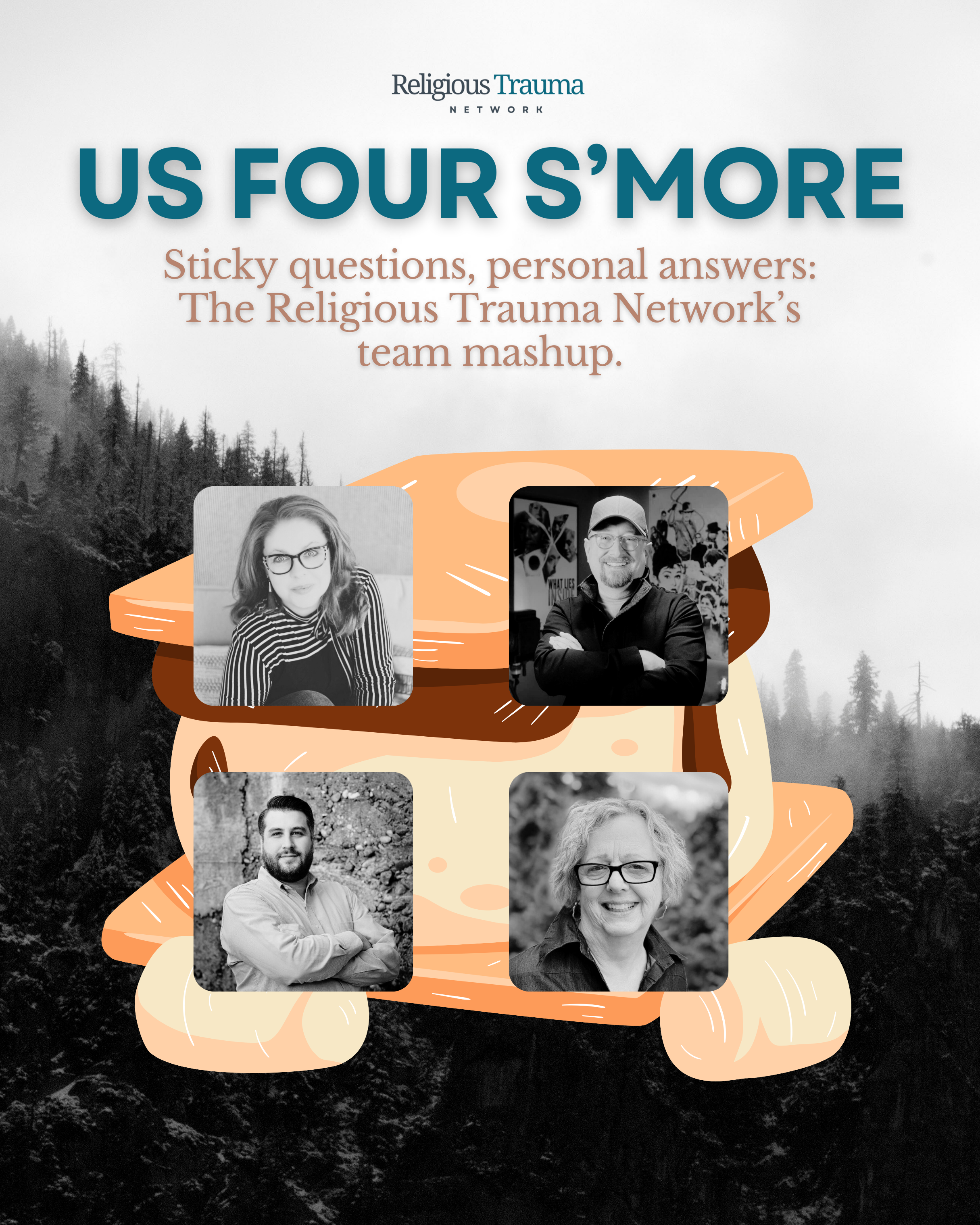
Sticky questions, personal answers: The Religious Trauma Network’s team mashup.
What’s one thing you wish your loved ones understood about your healing?
Rebekah Drumsta
I’m not sure I can give a specific answer to this question, because healing—especially in families—is never one‑dimensional. But if I had to choose one thing I wish my loved ones understood, it’s this: my healing and journey is rooted in my own internal work, not in anyone else’s role or response.
While yes, some of this process is connected to you—because I’m healing from wounds that came from our relationships and experiences. But the work I’m doing now is about what I need to heal, grow and create a healthy and full life going forward. It’s not about you, your expectations of maintaining family image, your “I tried,” or your “how could you do this to me.” (Although the ripple effect of decisions and my family has most certainly been considered...and observed.) Love doesn’t demand that I minimize my pain or what happened to me to protect someone else’s comfort. Love wants healing, even when it requires humility and the courage to admit you may have hurt someone, even unintentionally.
I also see now that my pain has affected you. Watching me struggle, react, change, and question has caused you confusion and grief. I understand that. Realizing that—and letting myself feel it—might be the strongest, hardest, bravest thing I can do some days.
But I need to be loved for who I am right now, not who you hoped I would be or who you think I should become. Healing asks me to show up as my current, pure self, not a version edited for your expectations.
And this isn’t just about my story. Our traumas are connected. Families and generations intertwine. Some of what I’m healing didn’t start with me—it’s inherited, absorbed, passed down. I didn’t ask for this work, but I did choose not to run from it.
So if there’s one thing I wish you understood, it’s that my healing is an act of courage, not rejection. It’s a commitment to repair—within myself, within our family line, and within the places where love and harm got tangled. I’m doing this so the story can change, not so the distance can grow.
David Ruybalid
I have listed out some of my thoughts, and this is my attempt to share them in a way that is kind-spirited but honest. One thing I wish my loved ones understood about my healing is that distance has been an essential part of it. Moving two mountain ranges away was not just a change of scenery, it was a shift in expectations. I no longer felt obligated to participate in every family event, and that freedom allowed me to become my own person. It gave me the space to grow and to help my family and me develop our own identity and traditions, separate from what had been imposed on us for so long. That distance, both physical and emotional, has been one of the most helpful and healing things that has ever happened to me.
I’ve also learned that systems and expectations are often unspoken, yet they are deeply felt. Even when I try to push back against them, they can still hold power simply because I am responding to them. Over time, I have learned to live as if those expectations don’t exist for me, as if they have no authority over my life. I know there have been times when this has frustrated my loved ones, because it can feel like I am a different person than the one they knew, someone who doesn’t see or follow the expectations I once felt bound by. Healing has meant learning to navigate these dynamics with compassion for myself and for my relationships, even when my choices aren’t fully understood.
Janyne McConnaughey
What a question! There are so many layers to my healing: religious trauma, sexual abuse trauma, and now political trauma. This year added medical trauma and left me walking to the end of 2025 with a cocktail of all of it. Ten years of healing from the religious trauma and sexual abuse enabled me to stay afloat, but it did not prepare me for the realization that unless I remained positive about my past traumas and how 2025 was impacting my journey of healing, family members and many friends no longer were willing to hear my lament or consider that my story and healing might have provided valuable insights on the current political or religious fronts. Unless I was willing to put on the mask of toxic positivity again, my voice was silenced in conversation after conversation with many (not all) family members and friends who had previously been very supportive.
It seems that the predominant idea of healing is that it will make you a happier, more spiritual person. What actually happens is
Healing helps you set boundaries around what you will and will not tolerate.
Healing offers insights that enable you to identify the unhealthy undertones in religious and political contexts.
Healing enables you discern whether communities or relationships are safe or unsafe.
Healing allows you to be vulnerable in a safe and supportive environment.
Healing creates a sensitivity that appreciates authenticity and recognizes inauthenticity.
Healing provides the courage to speak the truth even when it makes others uncomfortable.
Nothing in that list resembles the happy, spiritual person that most who have not walked this journey believed would arrive at the end of my healing. They were quite satisfied with me being just a better version of who I was before healing. Yet, the more I healed, the better that list described me, and that, I understand, was unexpected.
Most of my life, I had equated spirituality with being compliant, obedient, positive, and nice. While growing more comfortable with who my healing allowed me to be, I wondered if I had moved away from my faith. Then I realized Jesus was none of what I was led to believe a healthy, spiritual person should be. I was losing the chains that trapped me in religion and never allowed me to be who God created me to be, but I was at the same time becoming more like Jesus. I cared more deeply about the hurting and marginalized and was certainly more outspoken when they were harmed.
Conveniently or inconveniently—I am not sure which is the case—my healing journey was at a time when politics turned my world upside down. I think many saw what I know to be the result of healing as becoming liberal or “woke.” I felt the pushback and learned to speak boldly. I also learned to set boundaries. This was unlike who I had been before healing, and relationships were last or damaged. I, of course, felt guilty about that because I was the one who looked less spiritual. But that wasn’t the case, and if there was one thing I wish my loved ones and friends understood about healing, it is that who one becomes as a result cannot fit in the box I lived in for most of my life, and this will make others uncomfortable, exactly like Jesus did.
Visit the Religious Trauma Network Resource Page or our personal bios for additional support or resources.
This article is not intended to treat or diagnose any condition. The authors are not licensed therapists or clinicians. Any advice or opinions given on this site are strictly individual observation and insights based on personal experiences and study. It should in no way take the place of professional assistance.