
Control
by Ruby Mae Pierce
Today I’m watching a documentary on a cult. One of many I have watched. They fascinate me. The psychological abuse feels familiar. Always looking to someone else to tell you what is true. My body reacts strongly to this. I’m not even sure exactly which piece it’s reacting to. I suspect it’s the control. My teeth chatter, my body is tense and I can’t get comfortable.
Control is so familiar.
My current life is the first time I have lived the way I want to live. Where I make all the choices and deal with all the consequences of my choices. This feels like freedom to me.
The thing with control is you can’t always tell where it starts and where it ends. It’s subtle until it’s not. It’s the example of the frog being put into cold water and slowly being brought to a boil. The frog doesn’t jump out because the change in temperature is so slow. It doesn’t notice. (A client once informed me that this story is not scientifically accurate. I’m not sure that matters though, because the picture describes the subtle nature of control).
Control in My Own Life
Truthfully, I can’t tell you where the control started in my marriage and where it ended. It started in small, seemingly insignificant ways while we were dating and even in bigger ways when something felt familiar enough that I didn’t question it. Like the shame I felt when I interrupted his studying to pick me up after I had fainted from giving blood. He refused. The messaging was that I should have known better. His studying was obviously more important.
The ending is a little more blurred. It didn’t stop when I left. A year after I left, he was dating my friend and pastor. There are still moments he tries to control. Four years after leaving, I am starting to push back, but pushing back feels weirdly wrong. I suspect it has been set up that way.
Gaslighting
I can’t tell you which areas of my life he controlled. You leave a relationship like this with a fucked up sense of what is real. You literally no longer know what is real. I have always given him the benefit of the doubt, but I know now he controlled more than I thought. In couples counselling, he reported that he manipulates people. Joking with my sister, he questioned whether he was a narcissist. And yet, I didn’t have a clue. It has taken me years to fully question every aspect of the marriage. From choosing to adopt children to my emails to what shows I wanted to watch to our sex life - there are memories of control everywhere.
Admitting this brings a sense of ick. I don’t want the vulnerable moments that we shared to be swallowed up by all of this. But I’m not sure any intimate, vulnerable moments were free from control. I would like to believe some moments of our relationship were real, especially at the beginning - it felt so exciting and refreshing. Dating him had brought me out of a depression. He was rescuing me. I think that is his theme - rescuing.
I don’t think he started with a plan to control me, but I do believe the control grew as more parts of our life fell outside his grasp. The clearest example was when he restrained me — which is assault — because I asked him to book a vacation.
Control feels like a big piece of our relationship. Control is the word that most people use to describe something about him. Our child has named control. His current wife previously named control. People who previously knew us will tell me that they knew to be careful around him - that something didn’t feel right. I wish I had that feeling when I met him.
Familiar Pattern of Control
But how could I have had that feeling? Control was normal growing up. Church controlled. Employers controlled. Family members controlled. My voice was the least desired and the most wrong. I expected control. Back then, I could not name control as it was never named growing up. It was just what you had to do. It was what was expected of you. It was the thing that I would have never seen walking into a marriage. I knew signs of verbal, sexual and physical abuse. I had no clue about emotional and psychological abuse, as they were familiar. I was not prepared for control.
All these connections are freeing. I grew up in a church that had rules about what to wear to church, how often you should be attending, that you should be volunteering for the church and that 10% of your income, even as a child, goes to the church. My earliest employer (and Christian family member) told me I couldn’t complain now that I made minimum wage. My voice was controlled. I was silenced. When this happened in my marriage, it was familiar. It didn’t feel wrong.
Even after the marriage ended, he controlled the narrative. I was labeled crazy, hysterical and emotionally unwell. I was admitted to a crisis centre. I was self-harming, spending hours upon hours in bed. Depressed. Coping with alcohol and weed. He had proof. I had none. How do you prove control when you don’t even know what it is? How do you prove it when it’s always been the expectation? How do you even name it?
He used this narrative to justify marrying my friend, who was my pastor, whom I had disclosed to. It was God’s will. Isn’t that control? Do you not have a choice to do no harm?
It takes years to peel back these layers of control. Church, family, friends, marriage. I’ll never fully even know all the layers. Now, any hint of control sends me into a fight response. Imagine dealing with authority after this. I need very understanding bosses and supervisors. I have to be able to talk things through and question. I question everything. There is no trust because what if there is control that I can’t see?
Control is the biggest invisible threat. I’m thankful that my child can already name it in a way I couldn’t. I like to believe that has something to do with my healing. I doubt that I will ever be able to fully heal in my lifetime.
I suspect my kids will spend time healing also. My kids have had a hard life. When I went to therapy for myself, my parenting started to change. As I started to heal, my parenting became more consistent and nurturing. I had more to offer my children. I now do all the things that control can’t do. I apologize, I mentor, I empathize with my kids. I aim to understand their experiences and to see who they are and not who I think they need to be. Through these experiences, I hope that they will have the freedom to trust safe people. I hope they will know to trust themselves over someone else’s knowledge.
Conclusion
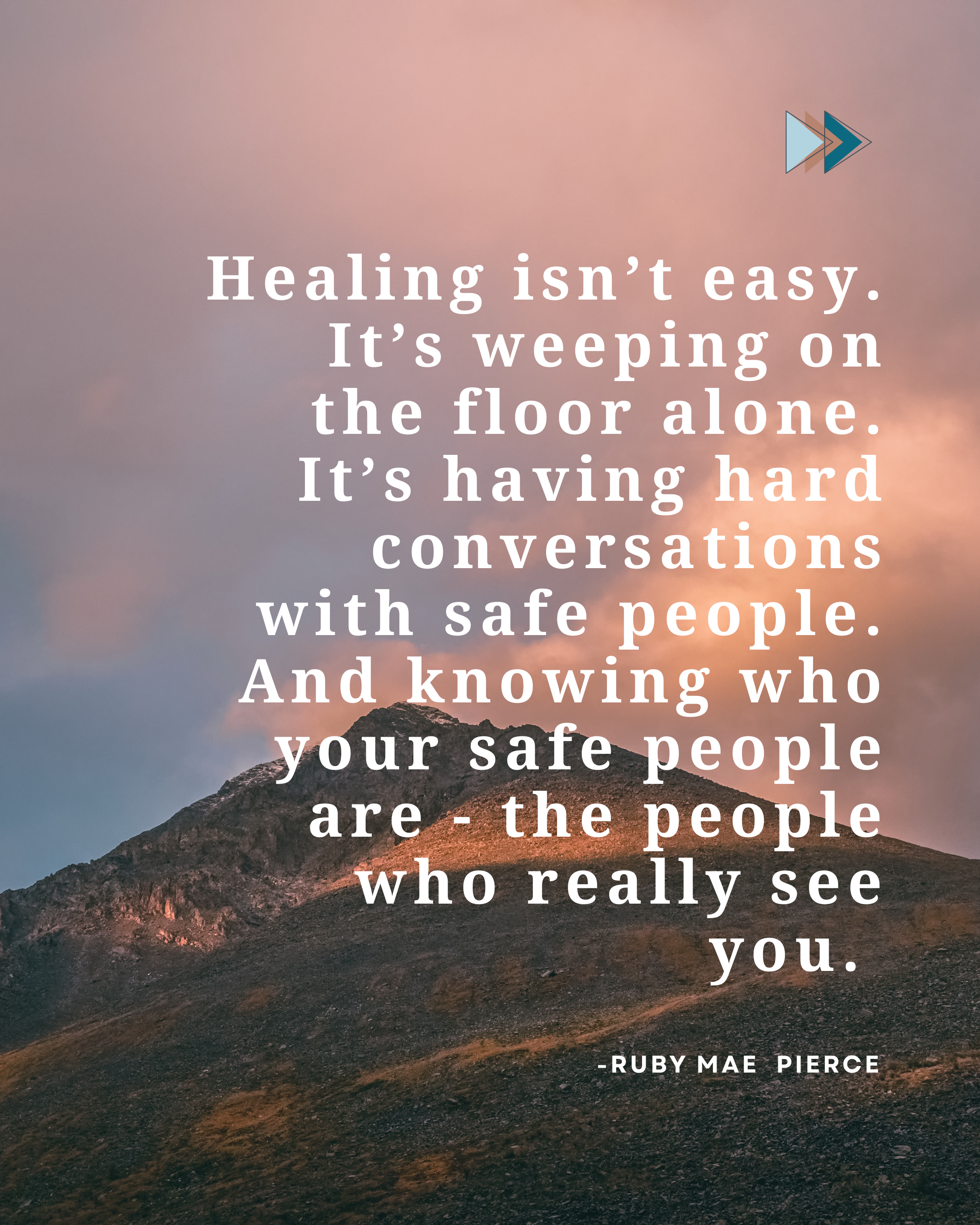
Healing isn’t easy. It’s climbing a steep mountain with no equipment and being knocked down again and again by rocks being thrown at you. It’s intentional showing up even when you don’t know what the end result is going to be. For me it was therapy, boxing, cold plunges, non-Christian friends who showed up without judgement when my Christian friends couldn’t. It’s weeping on the floor alone. It’s having hard conversations with safe people. And knowing who your safe people are - the people who really see you.
There is no happily ever after ending here. I have been in therapy for the last four years dealing with the various forms of trauma from my marriage, from growing up and from the church's response to my disclosure. I still gaslight myself, thinking it couldn’t have been that bad. But then I remember that I still have symptoms of trauma. I cannot step into a church. I no longer call myself a Christian as I do not want to be associated with people who dehumanize or harm others. I have clearer boundaries. I know myself better and make decisions that honor who I am and my own values. I feel joy now. Every time I break an expectation that someone had for me that isn’t consistent with my own, I giggle with freedom. I am the strongest physical, mentally and emotionally that I have ever been. And I am happy.
About the Guest Author:
Ruby Mae Pierce is a therapist doing her own therapy. She is a forty-year-old divorced, single mom of two kids, peeling back the layers of deconstruction and building her own voice while slowly examining unhealthy patterns and reestablishing healthy relationships in their place.
Disclaimer:
The views, thoughts, and opinions expressed in guest blog posts are those of the individual authors and do not necessarily reflect the positions of the Religious Trauma Network. We recognize that each person’s healing journey is unique, personal, and courageous. The stories shared here belong solely to the contributors, and their experiences, perspectives, and advice may not apply to everyone. We encourage readers to honor their own paths and seek professional support as needed.